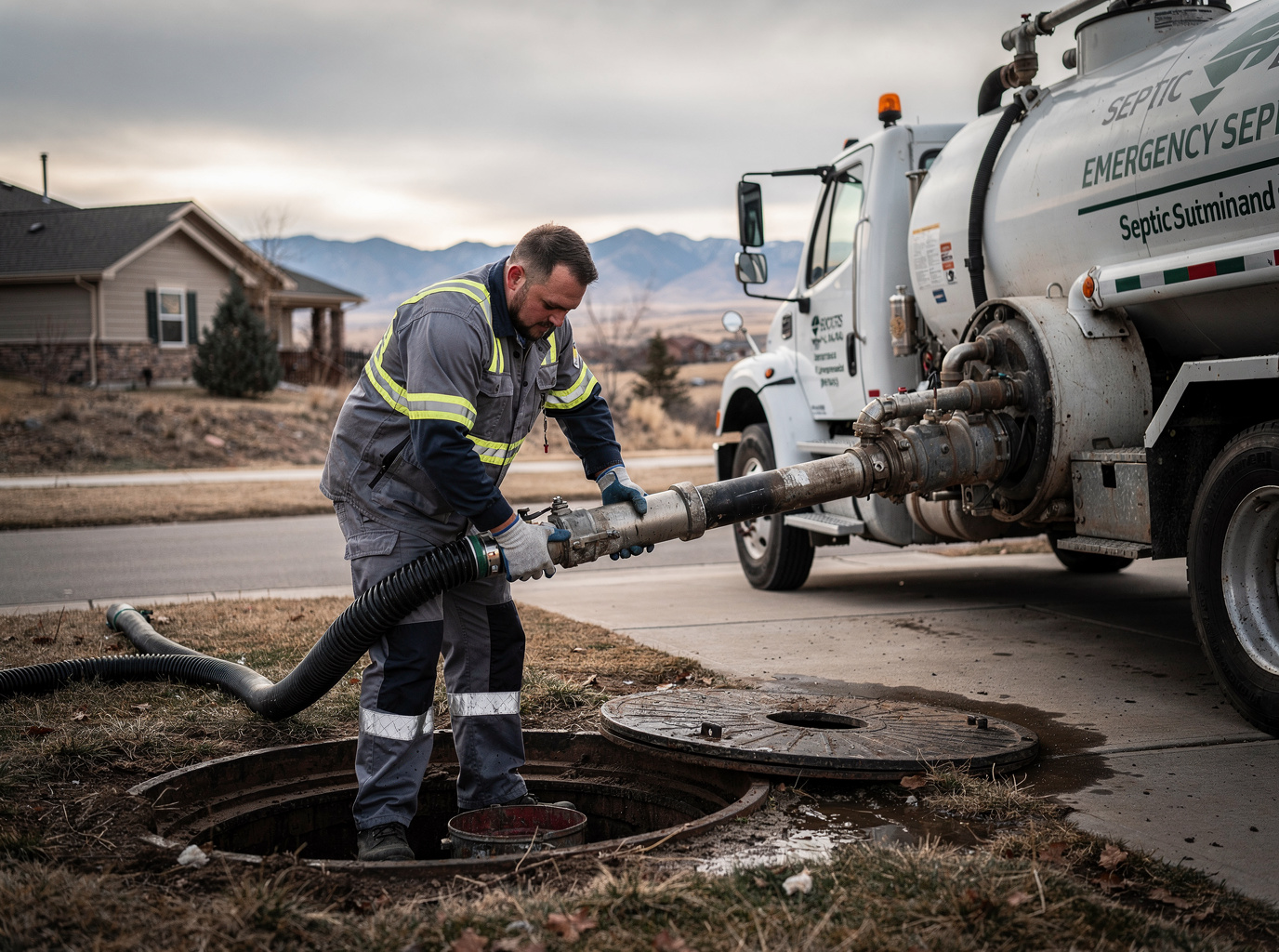
Littleton’s older neighborhoods such as Historic Littleton and Bowles contain many homes built before 1980 that still rely on original concrete tanks sized for smaller households. When a drain field becomes saturated after a spring snowmelt or a sudden summer downpour, solids can push into the outlet tee and create an immediate backup. An emergency call often means the crew must first locate the tank lid under mature landscaping or driveways added decades later, then pump under low-light conditions while keeping effluent contained so it does not reach nearby irrigation ditches common along the South Platte corridor.
Arapahoe County soils are predominantly clay-loam with low permeability, so even moderate rainfall can raise the water table quickly around tanks in Wolhurst and Southpark. This forces crews to work more slowly to avoid collapsing sidewalls during pumping and to note any standing water that signals the need for a later camera inspection. Homeowners in these pockets sometimes mistake a gurgling toilet for a simple clog, yet the real issue is often a full tank combined with a seasonally high water table that prevents normal outflow.
Winter freezes add another layer. Nighttime lows below 20°F can ice over the access riser or the outlet line on properties near Hudson Gardens and the Littleton Museum, turning a routine pump into a longer job that requires thawing before the truck can finish. Crews based at 5900 S Santa Fe Dr keep heated hoses and extra risers on the truck for these calls, especially on weekends when the schedule runs 9am–2pm.
Because Littleton sits at the edge of the Denver metro, traffic on Santa Fe Drive and Bowles Avenue can add 20–30 minutes to response time during rush hour. Dispatchers therefore ask callers whether sewage is already at floor level or merely slow-draining so they can prioritize true overflows over convenience requests.
Technician insight
In Littleton the thing that catches most people out with Emergency Septic Pumping is the clay-heavy Arapahoe County soil around older tanks in Historic Littleton and Wolhurst. A single wet spring can push the water table high enough that a tank that was fine in October is suddenly at capacity by April, and homeowners often wait until sewage reaches the floor before calling.
Backup on a Saturday Morning in Columbine
A homeowner in Columbine noticed slow drains Friday night after heavy rain. By Saturday morning sewage was at the clean-out. The crew from 5900 S Santa Fe Dr arrived within two hours, located the buried lid under a new patio, pumped 1,200 gallons, and found the outlet tee blocked by roots that had entered during the wet spring. They cleared the line on site and advised a follow-up camera inspection the next week.
Emergency Septic Pumping Services We Offer
✓After-Hours Septic Tank Pumping
Same-day response outside normal business hours for backups that cannot wait until the next weekday.
✓Septic Overflow Response
Rapid pumping plus containment of effluent that has surfaced in yards or near Sterne Park properties.
✓Holiday Emergency Pumping
Service on weekends and holidays when family gatherings increase water use and push tanks past capacity.
✓Commercial Emergency Pumping
Larger-volume pumping for restaurants and small businesses in Downtown Littleton that experience sudden clogs.
✓Frozen Riser Thawing
Safe thawing of access points and outlet lines on tanks in Columbine and Wolhurst during extended cold snaps.
Emergency Septic Pumping Cost in Littleton, CO
| Service | Typical Range | What Affects It |
|---|---|---|
| Standard Emergency Residential Pump | $350–$550 | Tank size and driveway access in Historic Littleton or Bowles |
| After-Hours or Weekend Call | $450–$700 | Holiday or late-night response in Columbine or Southpark |
| Frozen Line Thaw Add-On | $125–$200 | Extra time required when risers are iced over |
| Commercial Tank Pump | $500–$850 | Larger volume or multiple compartments common in Downtown Littleton businesses |
Ranges are typical for Littleton, CO and confirmed with an exact written quote before any work starts.
How it works
- 1
Intake and Dispatch
Caller describes symptoms and location; dispatcher confirms address in Littleton or adjacent Englewood and sends the nearest truck.
- 2
Site Arrival and Safety Check
Technician locates the tank, verifies power and water access, and sets up containment before opening the lid.
- 3
Pumping and Inspection
Tank is emptied, baffles checked for damage, and any standing water or root intrusion noted for the homeowner.
- 4
Cleanup and Advice
Area is restored, paperwork left with next maintenance date, and any immediate red flags such as cracked lids are flagged.
Pricing
Emergency rates apply outside Mon–Fri 8am–6pm and Sat 9am–2pm; final price depends on tank size, access difficulty, and time of day.